

Understanding the Core Differences: Spotify Duo vs Family Plan
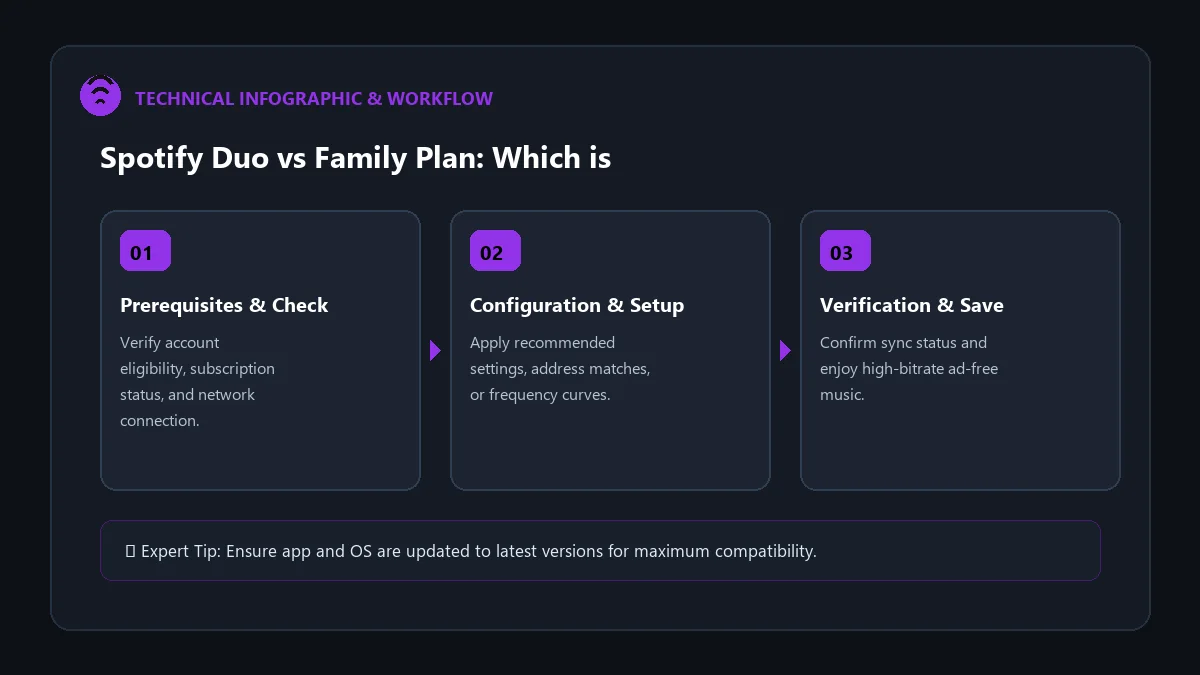
Choosing between Spotify Premium Duo and Spotify Premium Family often comes down to two simple factors: how many people live under your roof and what level of account management you need. While both plans deliver identical ad-free streaming, high-fidelity offline downloads, and unlimited track skipping, their underlying architecture and pricing structures cater to distinctly different household dynamics.
In this comprehensive breakdown, we examine the precise spotify duo vs family plan difference, covering direct cost-benefit ratios, account autonomy, curated joint playlists, parental filters, and Spotify’s strict household verification protocols.
Side-by-Side Comparison: Duo vs. Family Plan
To help you evaluate both options immediately, here is an executive comparison of key features, limits, and technical specifications:
| Feature | Spotify Premium Duo | Spotify Premium Family |
|---|---|---|
| Allowed Accounts | 2 Individual Premium Accounts | Up to 6 Individual Premium Accounts |
| Standard US Monthly Price | $14.99 / month | $19.99 / month |
| Cost Per Person (Max Capacity) | $7.50 / person | $3.33 / person (with 6 users) |
| Exclusive Shared Features | Duo Mix / Shared Blend Playlist | Family Mix & Spotify Kids App |
| Parental & Explicit Content Controls | No explicit filter management | Yes, Master Admin controls explicit toggles |
| Address Verification Requirement | Both members must share identical home address | All 6 members must share identical home address |
| Audio Quality & Offline Limits | Very High (320kbps), 10k songs on 5 devices each | Very High (320kbps), 10k songs on 5 devices each |
1. Financial Analysis: Which Plan Saves You More Money?
When calculating long-term value, standard individual Spotify Premium costs $11.99 per month. For two individuals sharing an apartment or home, purchasing two separate Individual subscriptions totals $23.98 monthly. Upgrading to Spotify Duo ($14.99/mo) results in an instant monthly saving of $8.99, amounting to nearly $108 in annual savings.
However, if your household includes three or more listeners—such as roommates, partners with children, or multi-generational families—the Spotify Family Plan ($19.99/mo) becomes mathematically superior:
- 3 Active Listeners: $6.66 per person per month (cheaper than Duo’s $7.50/person rate).
- 4 Active Listeners: $5.00 per person per month (over 58% discount vs. Individual).
- 6 Active Listeners: $3.33 per person per month (the highest per-user discount available on any major streaming service).
2. Account Privacy and Listening Autonomy
A common misconception among first-time subscribers is that shared plans combine listening history, recommendations, or algorithmic discovery. In reality, both Duo and Family provide completely separate, sandboxed accounts.
What Remains Completely Private:
- Daily Mixes & Discover Weekly: Algorithms analyze each member’s private listening habits independently.
- Saved Libraries & Liked Songs: Neither partner nor family members can see private playlists unless explicitly shared or made public.
- Spotify Wrapped: End-of-year statistics and listening metrics reflect strictly your personal stream time.
- Login Credentials: Each member logs in with their own email, username, and password.
3. Exclusive Features: Duo Mix vs. Spotify Kids & Parental Controls
Beyond account limits and pricing, each tier includes proprietary software features designed for specific household use cases.
Spotify Premium Duo Perks
Duo is designed around couples and two-person households. Its standout algorithmic feature is the Duo Blend, a continuously updating smart playlist combining tracks both listeners enjoy. Listeners can toggle moods between ‘Chill’ and ‘Upbeat’ depending on whether they are cooking dinner, working out together, or taking a road trip.
Spotify Premium Family Perks
The Family tier includes enterprise-grade household controls tailored for parents and guardians:
- Spotify Kids App: A dedicated, child-friendly app featuring curated sing-alongs, soundtracks, audiobooks, and bedtime stories free of mature content and ads.
- Explicit Content Filter Management: The primary account holder (Plan Manager) can restrict explicit tracks from playing on specific sub-accounts with a single switch in the account dashboard.
4. Household Address Verification: How Spotify Enforces Location Rules
Spotify’s Terms of Service explicitly mandate that all members of a Duo or Family plan must reside at the same physical address. When joining either plan, members are prompted to enter the exact physical address registered by the Plan Manager.
Pro Tip: Spotify uses geolocation verification (via GPS coordinates on mobile and IP/postal address mapping). If an invited member enters an address formatted differently (e.g., ‘Apt 4B’ vs ‘Apartment 4-B’), the invitation may fail. Ensure all invited members paste the exact string used during plan initialization.
Final Recommendation: Which Plan Should You Choose?
If exactly two people live in your home and you do not require parental controls, Spotify Premium Duo is the streamlined, cost-effective choice. If your household contains three or more music enthusiasts, or if you have younger children who need age-appropriate listening environments, Spotify Premium Family offers unbeatable value and comprehensive supervisory tools.
Frequently Asked Questions
Can two people live in different cities on Spotify Duo?
Officially, no. Spotify’s terms require all Duo and Family members to live at the same primary residence. Spotify periodically asks users to verify their home address using location check-ins.
What happens to my existing playlists if I join a Duo or Family plan?
Your playlists, saved albums, liked songs, and listening history remain 100% intact. Joining a shared plan simply changes your billing method from Individual to the shared plan administrator.
Can the Family Plan manager see what other members are listening to?
No. The plan manager only manages billing, member invitations, and explicit content permissions. They have zero access to other members’ listening logs, search histories, or private playlists.